Why 88% of Contact Centers Use AI and Only 25% Get Results From It

Contact Centers

AI Calling

The contact center industry has an uncomfortable gap between adoption and impact. The global AI customer service market has reached $15.12 billion in 2026, growing at 25.8% annually. 88% of contact centers are using AI in some capacity. And yet only 25% have fully integrated it into daily operations. That gap is not a technology problem. It is a deployment problem. And until organizations learn to close it, the promised economics of AI-powered service will remain a projection rather than a result.

This Metric Has Exposed Everything...

For years, contact center leaders measured success by deflection. How many calls did we keep away from a human agent?

That metric has become almost meaningless.

Deflection measures activity. It says nothing about whether the customer’s problem was actually solved. And when a deflected interaction fails to resolve, it generates a costly follow-up, erases any savings, and leaves the customer worse off than if they had reached a human in the first place.

Gartner benchmarks traditional self-service at $1.84 per contact versus $13.50 for agent-assisted interactions, a compelling cost difference on paper. The problem is that traditional self-service fully resolves only 14% of issues.

The math only works if the AI actually resolves the problem. Deflection without resolution is theater. The metric that matters in 2026 is autonomous resolution rate: the percentage of interactions completed start to finish without human intervention.

What Resolution Actually Requires

The reason so few organizations have crossed from adoption to integration is that resolution requires something most deployments lack: backend access.

A chatbot that can answer questions is a FAQ page with a conversational interface. An AI agent that can process a refund, update an account, rebook a flight, or file a claim is a fundamentally different system.

AI-native platforms that are integrated into backend systems achieve first contact resolution rates of 55% to 70%, compared to 14% for traditional self-service. The difference is not the model. It is the integration depth.

This is why the “bolt-on AI” approach consistently fails. Intelligence layered on top of legacy infrastructure cannot take meaningful action. And without meaningful action, there is no resolution.

bolt-on AI approach (often called “AI retrofitting”) refers to the practice of adding artificial intelligence tools such as chatbots, analytics modules, or automated assistants onto existing, legacy software platforms without fundamentally changing the underlying architecture.

The Consumer Preference Tension Leaders Are Not Discussing Honestly

There is a data point that gets repeated frequently in AI vendor decks: 51% of consumers prefer bots for immediate service.

What those decks rarely include is the full picture.

79% of Americans still prefer interacting with a human over an AI agent for customer service overall. The 51% bot preference applies specifically when customers want an immediate response and have a simple query. For serious issues like fraud or security concerns, 70% of customers want a human. For simple tasks like order tracking, only 19% insist on one.

The takeaway is not that customers reject AI. It is that their tolerance for AI is task-specific and drops sharply when stakes rise. Deploying autonomous resolution on high-complexity, high-emotion interactions without a clear human escalation path is one of the fastest ways to destroy customer trust at scale.

The winning model is not AI replacing humans. It is AI handling the high volume, low complexity interactions with speed and accuracy, and handing off to humans when the situation demands judgment, empathy, or accountability.

The Legal and Reputational Exposure No One Has Priced In

Two case studies from the past two years should be required reading for every leader deploying customer-facing AI.

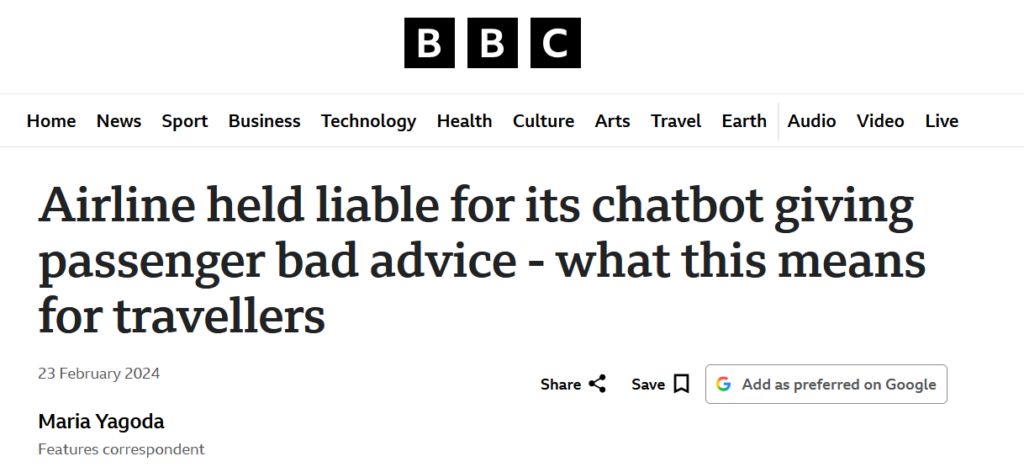
Air Canada.

The BC Civil Resolution Tribunal found Air Canada liable for negligent misrepresentation after its chatbot gave a customer incorrect information about bereavement fares. Air Canada attempted to argue the chatbot was a separate legal entity responsible for its own actions. The Tribunal rejected this outright, ruling that the airline was responsible for all information on its website, whether it came from a static page or a chatbot.

The message is unambiguous: your AI is legally an extension of your organization. You cannot outsource accountability to the model.

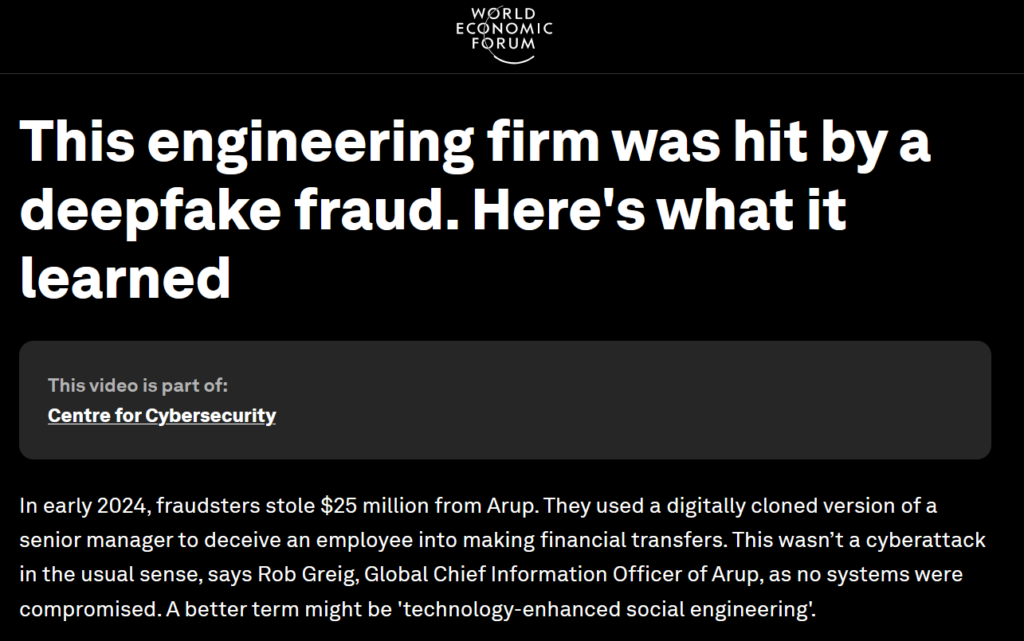
Arup.

In early 2024, an Arup employee transferred $25 million to fraudsters after a video call in which every participant, including the CFO, was an AI-generated deepfake. No internal systems were compromised. The attack exploited human psychology and visual trust, not technical vulnerabilities.

As AI makes voice and video indistinguishable from reality, verification can no longer rely on what something looks or sounds like. Cryptographic authentication and out-of-band verification are no longer optional for high-value transactions. They are the minimum.

The Failure Pattern That Keeps Repeating

Approximately 80% of AI projects in customer service fail to reach production or deliver positive ROI. The failure pattern is consistent. Organizations treat AI deployment as a big-bang modernization effort, attempting to replace legacy systems all at once rather than building iteratively with verified results at each stage.

The implementation sequence that actually works looks different:

  • In the first four weeks, ingest and transcribe calls without changing anything. Identify what is actually failing in current workflows, not what leadership assumes is failing.
  • In weeks five through eight, automate post-call work such as summaries and CRM updates. This creates visible, measurable value for agents, builds internal credibility, and generates the buy-in needed for the next phase.
  • In weeks nine through sixteen, deploy real-time AI assistance in suggestion mode. Let humans validate AI recommendations before moving to autonomous responses.
  • Only then, with clean data and demonstrated accuracy, does it make sense to move toward autonomous resolution at scale.
Article content

The organizations that skip this sequence and deploy autonomous AI on complex interactions before establishing accuracy baselines are the ones generating the failure statistics.

What Verification Actually Means in 2026

AI voice strategy in 2026 is increasingly defined by one concept: verification as product.

As AI-generated voice and video reach near-perfect fidelity, the ability to authenticate that an interaction is what it claims to be has become a core business function, not a security afterthought.

The Arup incident shows that attackers no longer need to breach systems or steal credentials. They can exploit the human instinct to trust what appears visually and verbally real. For any high-value transaction, organizations must implement verification that operates outside the communication channel itself, through out-of-band callbacks, authentication codes, or mandatory secondary approval.

In a world where voice can be cloned and faces can be fabricated in real time, accuracy and auditability are brand assets. Every autonomous resolution needs to be verified, logged, and explainable.

That is not a compliance requirement. It is a trust requirement.

Honestly for 2026,

The economics of autonomous AI in customer service are real. Gartner projects $80 billion in contact center labor cost reductions from conversational AI by the end of 2026. The efficiency gains are documented. The resolution rate improvements are measurable.

But most organizations are not there yet.

The gap between adoption and integration is where the value lives and where most organizations are stuck. 88% have deployed something. 25% have built something that works end to end.

The question worth asking is not whether your organization uses AI in customer service. Nearly every enterprise does. The question is whether your AI is actually resolving problems, or whether you have deployed an expensive version of “please hold.”

Where does your contact center sit on that spectrum? Drop your perspective in the comments.

At Crizzen, we help organizations move from AI deployment to AI that resolves. If your contact center is navigating the gap between adoption and integration, we are happy to help map the path.

This article is part of the Crizzen Enterprise AI Playbook exploring how AI is reshaping operational models across industries.

#callcenter #customerservice #bpo #contactcenter #business #telemarketing #artificialintelligence #ai #digitaltransformation #data #automation #EnterpriseAI #Crizzen

Sources: Gartner Contact Center Benchmarks 2026; Fortune Business Insights AI Customer Service Market Report; Zendesk CX Trends 2026; SurveyMonkey Consumer AI Preferences Study 2025; BC Civil Resolution Tribunal, Moffatt v Air Canada 2024; World Economic Forum, Arup Deepfake Case Study 2025; McKinsey Contact Center Automation Analysis; Avaya CX Statistics 2026


Leave a Reply

Your email address will not be published. Required fields are marked *

Workview Demo Form

Try TickL Beta Now