
India’s roads are among the most complex operating environments in the world. Urbanization continues to accelerate. Vehicle density is rising. Infrastructure expansion is ongoing, but often lagging behind demand.
The result is not only congestion. It is a structural safety challenge.
With approximately 474 lives lost every day, road safety now has direct implications for economic productivity, healthcare burden, and urban quality of life. The core issue is not effort. It is scale.
Manual enforcement and static systems cannot process millions of real-time decisions across intersections, highways, and mixed traffic conditions. In a system where two-wheelers form a large majority of vehicles, variability is high and predictability is low.
This is where intelligent systems begin to matter.
From Reactive Control to Adaptive Traffic Systems
A key shift underway in Indian cities is the move from reactive control to adaptive traffic management.
In Bengaluru, for instance, adaptive traffic signal systems adjust signal timings based on real-time traffic flow across a large network of intersections. These systems continuously re-calibrate signal cycles
to reduce congestion and idle time.
The impact extends beyond convenience. Reduced idling lowers fuel consumption across thousands of vehicles. Traffic throughput improves without requiring additional road capacity. Small efficiency gains at
each intersection compound into meaningful system-wide improvements.
At the national level, infrastructure agencies are beginning to explore AI-enabled monitoring frameworks to track construction progress, detect inefficiencies, and improve asset lifecycle management. This reflects a broader transition from static infrastructure to responsive infrastructure.
What Early Deployments Are Showing
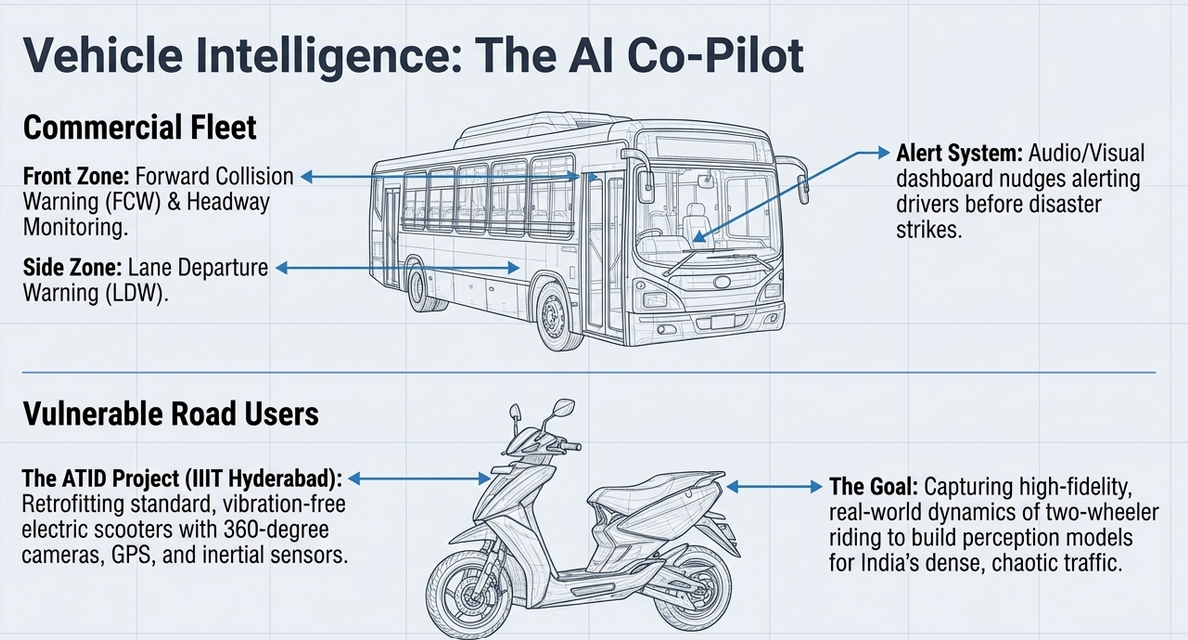
Pilot programs across Indian cities offer useful insight into what AI-enabled mobility systems can achieve. The iRASTE initiative in Nagpur provides one such example.
In controlled deployments, public transport vehicles equipped with advanced driver assistance systems recorded significantly lower accident rates compared to conventional vehicles. Real-time driver feedback and cabin-based interventions also contributed to measurable improvements in driving behavior.
One of the more important shifts introduced through such systems is the move from static blackspot identification to dynamic risk detection. Instead of identifying accident-prone areas after incidents occur, systems can flag emerging high-risk zones based on real-time patterns.

This allows earlier intervention. Behavioral nudging systems have also shown promise in improving compliance with traffic signals and road rules. These approaches indicate that safety outcomes can improve not only through enforcement, but also through timely feedback and awareness.
While results vary across deployments, these pilots suggest that AI can play a meaningful role in reducing accident risk and improving overall traffic discipline when implemented with the right context.
The Economic Case for Intelligent Mobility
The value of AI in traffic systems is not limited to safety. It is economic. Every avoided accident reduces healthcare costs, insurance burden, and productivity loss. Every reduction in congestion translates into
fuel savings and time efficiency. Every improvement in infrastructure utilization increases the return on public investment.
For governments operating under fiscal constraints, these gains are significant. AI does not simply optimize traffic. It improves how effectively public resources are used.
The Regulatory Gap That Needs Attention
As AI systems become more embedded in mobility infrastructure, regulatory readiness becomes critical. These systems rely on large volumes of data, including vehicle movement patterns and behavioral signals. The Digital Personal Data Protection Act 2023 introduces clear requirements around consent, purpose limitation, and data handling.
There is also the question of accountability. Existing frameworks such as the Motor Vehicles Act were designed for human decision-making environments. As AI systems begin to influence outcomes, questions around liability, auditability, and oversight become more complex.
Algorithmic bias is another consideration. Systems used for enforcement must be designed to ensure fairness and consistency across different user groups.
Finally, fragmented state-level implementation can create interoperability challenges. Without alignment, scaling intelligent mobility systems across regions becomes difficult. Addressing these
issues is essential for long-term adoption.
The Road Ahead: Toward Intelligent Mobility Ecosystems
India’s mobility transformation will be driven by systems integration and not just by isolated technology deployments. Traffic signals, enforcement platforms, public transport networks, and infrastructure planning will need to operate on shared intelligence.
Decisions will need to move closer to real time. Safety will need to shift from post-incident response to early risk anticipation. This transition is already underway, though unevenly.
India does not lack roads. It lacks intelligent systems managing them. AI does not replace traffic authorities. It extends their ability to operate at scale. Cities and states that adopt this shift early will not only improve safety outcomes, but also define the blueprint for efficient, high-density mobility systems in the future.
Exploring Intelligent Mobility Systems
For stakeholders working across urban mobility, transport infrastructure, and smart city initiatives, the question is no longer whether intelligent systems will play a role.
It is how they will be designed, governed, and integrated into existing ecosystems.
If you are working on mobility systems or public infrastructure, it would be valuable to exchange perspectives on what practical, scalable AI implementation could look like in your context.
This article is part of the Crizzen Enterprise AI Playbook exploring how AI is reshaping operational models across industries.
#Logistics #Infrastructure #IndianRoads #SupplyChain #Transportation #EnterpriseAI #Crizzen